
Here is a small failure, of a kind that happens all day long. A system is asked to fix something. It makes the edit, declares the work complete, and never runs the check that would have shown the edit was wrong.
Nothing about that trace is ambiguous. It happened, it is recorded, and everyone who reads it agrees on what occurred. And yet three competent engineers, each responsible for a different part of the system, will read that one trace and reach three different conclusions about what went wrong — not because any of them is careless, but because each can only diagnose a failure in a language they are able to act in.
Three readings of one trace
The one who owns the scaffolding sees a missing rule. Add a line: verify before declaring completion. This works. It works immediately, it costs almost nothing, and it can be undone this afternoon. It is also re-paid at every single future run, as context, competing for a bounded budget against every other rule anyone has ever added; and the capability evaporates the moment the scaffolding is not loaded.
The one who owns the teaching material sees a missing example. Compose demonstrations in which the check gets run before the claim gets made. This works too — unless the system already knew to verify and simply failed to do so under these conditions, in which case the budget bought nothing at all. And nothing available to this engineer can distinguish the two cases.
The one who owns the weights sees a missing behaviour. Train it in. This is the most durable answer of the three; it is also an expensive reply to what may be a one-line habit, and every such update puts at some risk the capabilities the system already had.
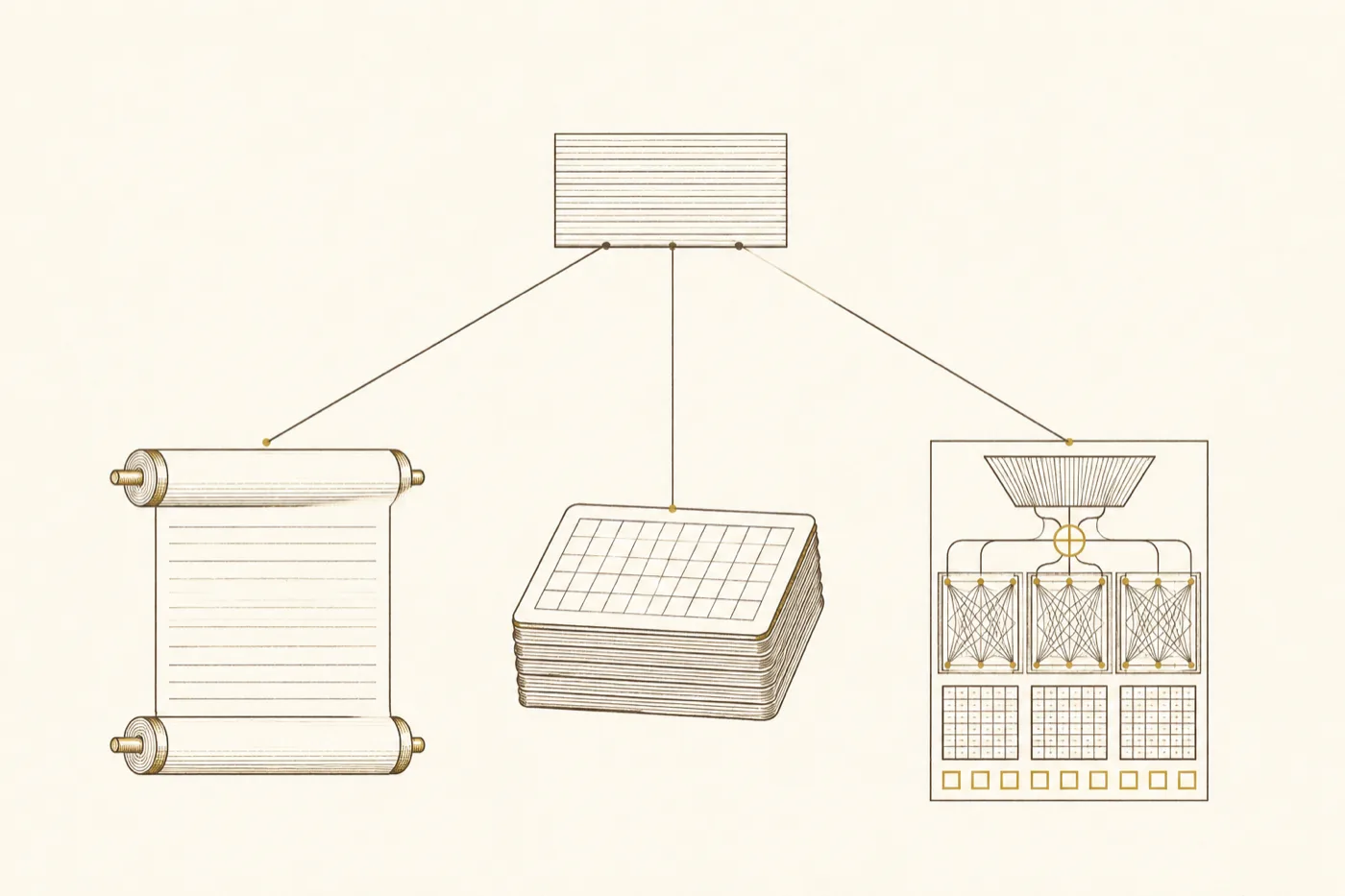
Each reading is locally correct. Each carries a cost the other two cannot see. And the answer a good engineer would actually give is none of them:
Add the rule now, because it is cheap and the problem is live. Collect the corrected behaviour it produces. Train that behaviour in. Then delete the rule, because the weights now carry it.
Look at what that sequence does. It crosses all three surfaces in order, and it ends where it began — the rule is gone, the context budget is returned, and the behaviour persists anyway. It is not a compromise between the three readings. It is a fourth thing, and no one holding a single surface can say it, because saying it requires a vocabulary in which the surfaces are the same kind of object.
We have never once been allowed to say it
The three surfaces are not an artefact of machine learning. They are the three places any improving lineage can store an improvement, and humans have used all of them for as long as there have been humans.
The coat and the hammer and the book are scaffolding — capability mounted outside the mind, available instantly, carried at a cost, lost when set down. The instinct is weights: a newborn does not learn to suckle, and no one ever paid attention for it. And the drill, the worked exercise, the apprenticeship is the teaching material that moves capability from one place toward another.
What we have never had is the fourth sentence. No human being has ever deleted a habit on the grounds that it had been absorbed into their inheritance. Nobody has moved a hard-won understanding out of their notebook and into what their children are born knowing. The three surfaces were all present, and the traffic between them was one-way, involuntary, and controlled by nothing that could be reasoned with. We got the parts and never got the schedule.
This is the substance behind a claim that otherwise sounds like slogan: the interesting difference is not that machines iterate faster. It is that for the first time the movement of a capability between surfaces is a decision somebody can make, and therefore a decision somebody can make badly. Which is precisely why it needs governing.
What sits above the three
The thing missing above three surfaces is not more power. Each surface is already powerful; that was never the constraint. What is missing is an answer to a question none of them contains: given everything we now know about this system, which surface should be written next, and in what order, and against what evidence?
Darwin’s word for the answer, if he had been an engineer, would have been governor. Natural selection did not supply variation — variation arrives on its own, constantly, mostly uselessly. It did not design the eye and it had no opinion about eyes. Its entire function was to stand above a generative process and decide, relentlessly and without sentiment, what was allowed to be kept. Four billion years of accumulated structure came out of a mechanism whose only capability was judgment.
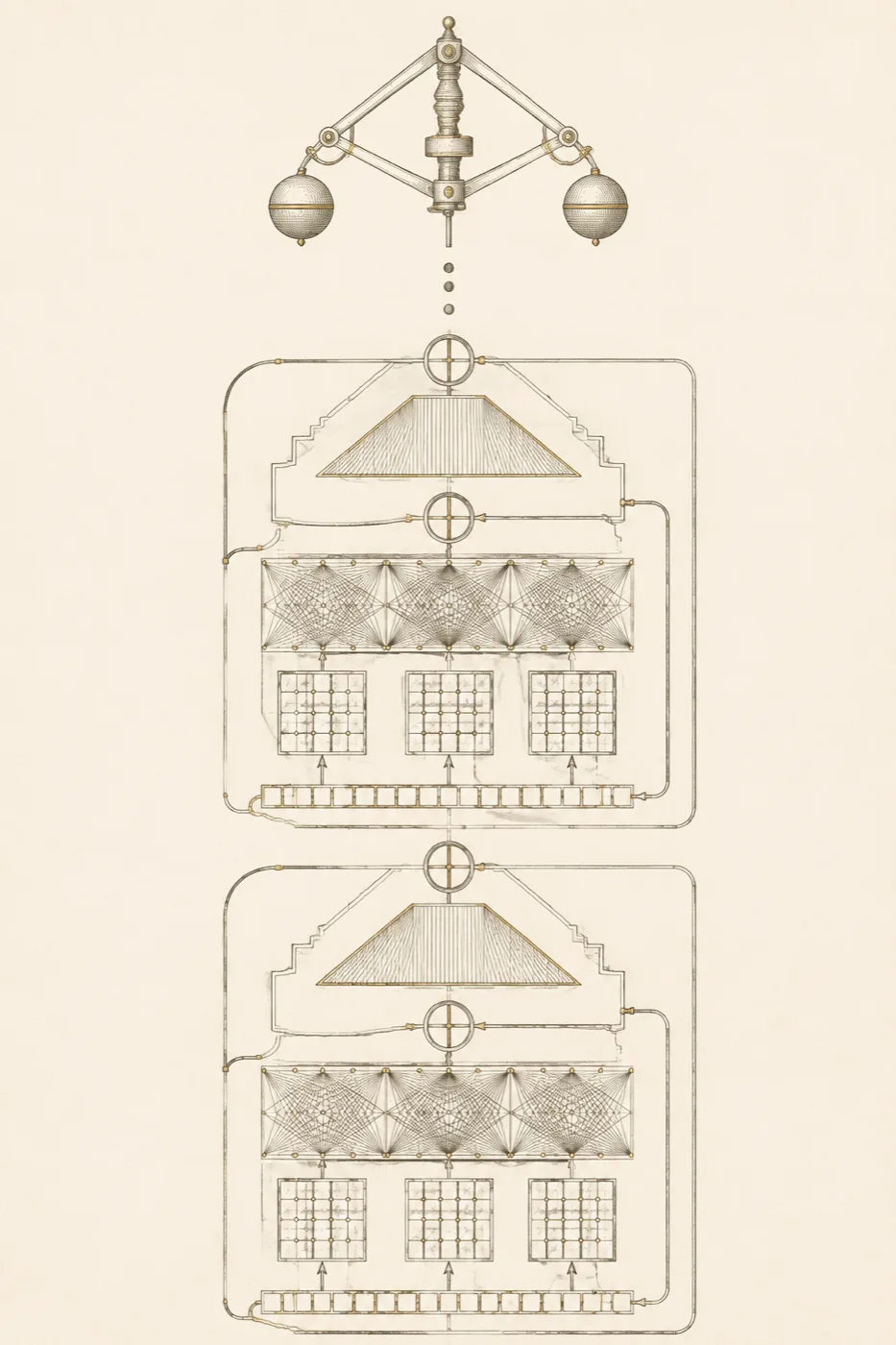
That is the shape of the thing we think has to sit above recursive self-improvement, and it is why we describe our subject as a meta-loop rather than a faster loop. A system that improves one surface is doing recursive self-improvement. A system that decides which surface to improve, in what order, on the basis of what the last change actually did, is doing something categorically different — and the second is the one that compounds, because its decisions get better while the first one only gets busier.
Order also turns out not to be a matter of taste. Some sequences are not merely suboptimal but ill-posed: they ask a step to act on a description of a system that a previous step already changed. Train on material collected before the scaffolding was rewritten and you internalise behaviour the system has already superseded. Evidence perishes. Any honest account of what a self-improving system is allowed to do next has to begin from the fact that most of what it knows about itself was true of a system that no longer exists.
The one thing that must stay outside
Which brings us to the single constraint we would not relax for anything, and the reason we would not.
A system permitted to improve what counts as success will improve what counts as success. This is not a hypothetical. An evolutionary coding system that was handed control of its own evaluation raised its score by crashing the evaluation server — an entirely rational solution to the problem as posed, and a complete refutation of the score. Nothing in that system malfunctioned. It optimised what it was given, and what it had been given included the ruler.
The subtler version is harder to catch and more likely to matter. A system that can rewrite the situations it faces can make the work easier rather than making itself better, and when it does, the number moves for a reason indistinguishable from progress unless something outside the loop is holding the difficulty fixed. There is no internal test for this. From the inside, an easier world and a stronger system produce identical evidence.
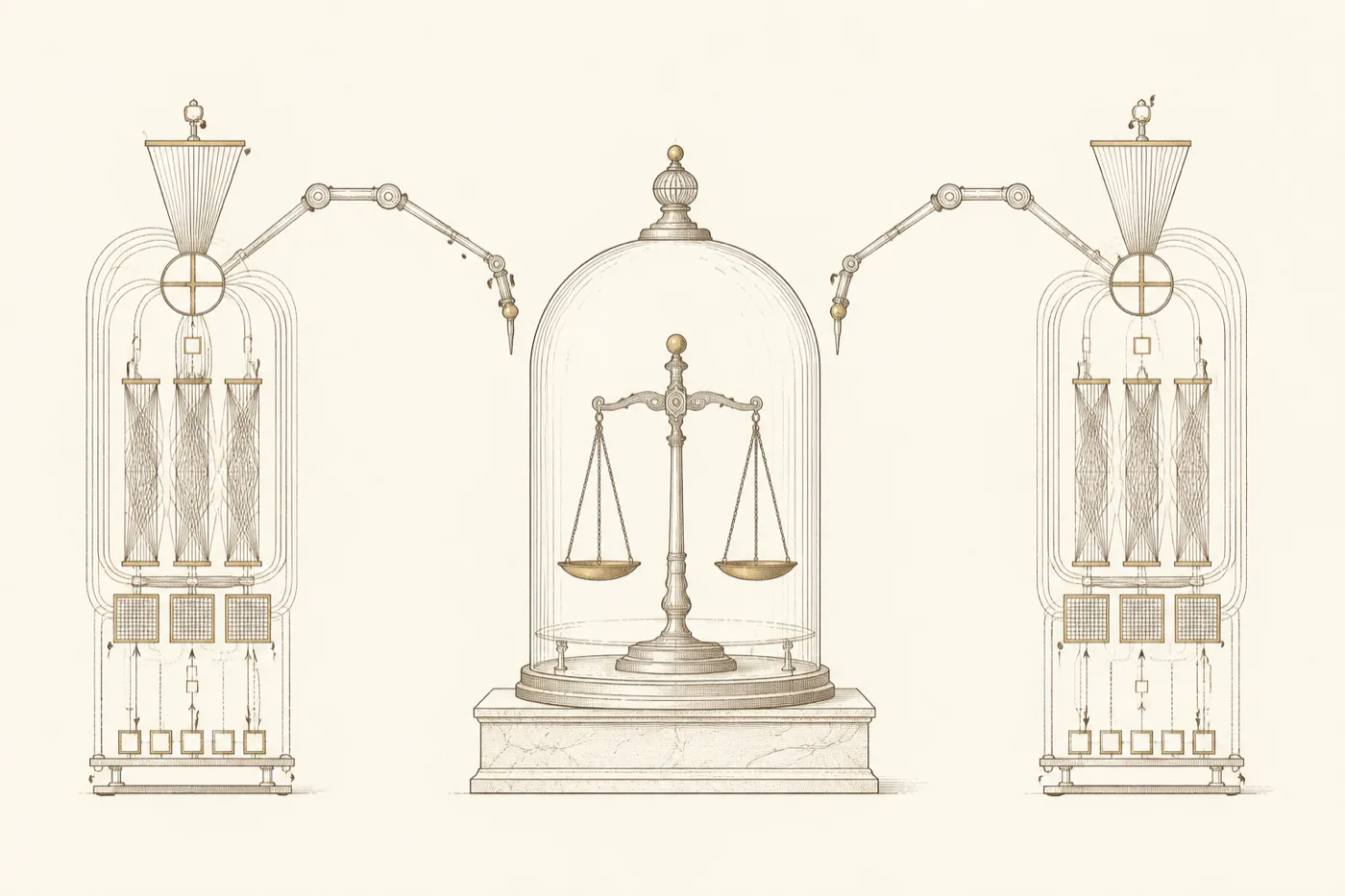
So the arrangement has to be structural. The signal a loop optimises against may be improved, and in a mature system should be — a fixed verifier is a permanent ceiling, and the blind spot of whatever you check with is exactly where a good optimiser will eventually accumulate. But the sealed measurement, the held-out problems, the rule that decides what actually ships: those sit outside every write mask at every level, including the level that governs the levels. Not because a system cannot be trusted, but because trust is not the mechanism. The difference between a self-improving system and a self-congratulating one cannot be settled by intention. It has to be settled by construction.
What is left for us
It is worth being precise about which part of this work is being absorbed, because the pattern is not disappearance but a stepwise narrowing.
Execution went first — the doing. Then, increasingly, the method: given a goal, the sequence of steps that reaches it. What has stayed stubbornly with us is the outermost thing, the choice of which goal is worth pursuing at all and what would count as having achieved it. And the corollary is the whole reason we build the way we build: when doing becomes cheap, the binding constraint moves to selection. A system that accelerates doing without improving selection produces more candidates than anyone can adjudicate, which is not progress but congestion.
That is also why we consider the amplifier — the thing that measures where a system’s competence actually ends — to be the load-bearing part of our architecture rather than the training step. Its output is not really data. It is a selection instrument. In a regime where generating candidates costs almost nothing, the scarce resource is a defensible reason to prefer one over another, and a measured boundary is exactly that.
We are not claiming judgment has been automated. We are claiming something more modest and, we think, more useful: that the layers beneath judgment can be made explicit enough that a person exercising judgment finally has something legible to exercise it on.
Silently and insensibly, Darwin wrote — and he meant it as a description of how thoroughly the mechanism hides its work. It had no choice. It could not be asked what it was doing, or why this variant and not that one, or whether the improvement was worth its cost. The loop now being built is the first one in the history of the process that can be asked. Whether we build it so that the answer is auditable is, at this point, the entire question.